I’m still buzzing from last night.
From the first haunting notes of “American Requiem,” it was clear this was no ordinary tour finale. Beyoncé has always been meticulous, but there was something more raw, more urgent, about this one. It felt like she knew this album had grown into something bigger than a music release. Cowboy Carter is not just an album; it is a reclamation. A conversation with history and identity. And on that stage, she seemed to be answering for all of us who have ever been told we don’t belong.
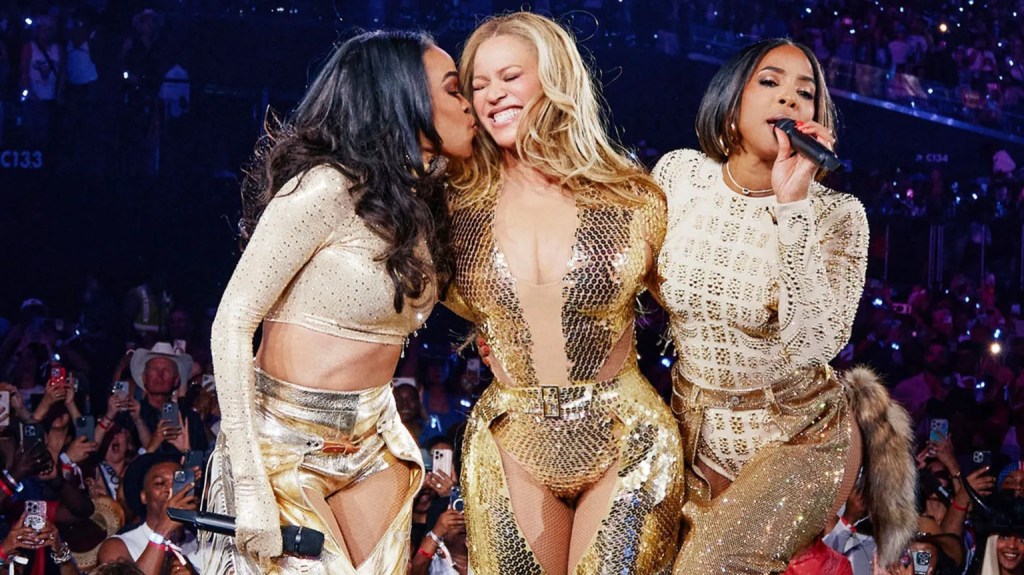
The surprise Destiny’s Child reunion nearly cracked the roof off the stadium. Shaboozey walked out to a roar that could have powered the Strip for weeks, proof that this album didn’t just borrow from country music, it expanded it. Blue Ivy danced like she was born for that stage. But beyond the celebrity cameos, beyond the immaculate choreography and flawless vocals, there was a deeper hum that lingered: this album matters.
A Personal Note on Country Roots
Growing up in Calaveras County, surrounded by farmers, FFA jackets, and county fairs, country music was everywhere. It was the soundtrack of long drives through winding foothill roads, of barn dances and rodeos, of quiet mornings when tractors were already moving before sunrise. I loved the sound, but I never quite felt like it loved me back. Country music often carried an unspoken message about who it was “for,” and kids like me didn’t seem to fit that mold.
When Beyoncé released Cowboy Carter, it felt personal. I thought about the teenagers I grew up with, blasting George Strait or Carrie Underwood in their trucks, and how I never saw myself reflected in that sound even though it shaped so much of my world. Beyoncé stepping into this space, unapologetically Black, unapologetically herself, felt like permission to love it again without feeling like an outsider.
At the Vegas show, as she sang about America’s contradictions and her own Southern roots, I felt my Calaveras childhood collide with this new, inclusive vision of what country music could be. It reminded me that the symbols of rural America: the cowboy hat, the wide-open sky, the music that tells its stories—don’t belong to just one kind of person. They belong to all of us.
The Cultural Impact of Cowboy Carter
What makes Cowboy Carter so extraordinary is how it reshapes the cultural landscape far beyond music charts. This album doesn’t just sit in one genre; it erases the idea that artists, particularly Black women, have to stay in one lane. For decades, country music was a space where Black voices were often erased, despite Black artists helping create the genre itself. Beyoncé didn’t just step into country music; she took the narrative back and built an entirely new house on top of it.
By spotlighting pioneers like Linda Martell and inviting artists such as Shaboozey to share the stage, Cowboy Carter honors the legacy of Black country while pushing it forward into a space that feels modern, inclusive, and unapologetically Black. It shows how culture evolves when walls are torn down and conversations are allowed to happen.
This album is also deeply symbolic in our political moment. It arrives in an America grappling with questions about who belongs, whose history matters, and whose voices deserve amplification. By wearing the cowboy hat, singing the hymns, and twisting the sound of Americana to reflect her own roots, Beyoncé is saying: we have always been here, and we always will be.
Cultural impact is rarely immediate, but you can feel it in the energy surrounding this album—how it has sparked debates, inspired artists, and shifted what people expect from country music and from Beyoncé herself. It’s not just an album; it’s a cultural artifact, one that will be studied for years as a turning point in how we talk about music, race, and American identity.
The Power of Witnessing
I have seen Beyoncé live before. She is always spectacular. But this show felt different, personal even as part of a massive crowd. I cried during “Protector” when the screens showed footage of mothers and children, a soft reminder that the legacy she is building is not just musical, it is generational. I screamed until my voice cracked during “Ya Ya,” a song that feels like the chaotic, beautiful energy of being alive right now, in this divided and messy country of ours.
Somewhere near the end, she looked out at us, smiled, and simply said, “Thank you.” It wasn’t scripted or polished. It was gratitude, from someone who understood the weight of what she had just accomplished—not just for herself, but for everyone watching.
Walking out of the stadium into the warm Vegas night, I felt something I haven’t felt in a long time: hope. Hope that art still has the power to cut through all the noise. Hope that stories of reclamation and belonging still resonate in a country that often feels like it’s at war with itself.
A Love Letter Disguised as an Album
Cowboy Carter is, at its heart, a love letter—to roots, to resilience, to a more honest version of America. It tells us that belonging doesn’t need permission and that the fences people build, whether genre fences, racial fences, or cultural fences, are illusions we can dismantle if we dare.
That is why this album had to be Album of the Year. Not just because it is sonically breathtaking, though it is, but because it represents what music at its best can do. It challenges us, stretches us, and stitches us back together when everything else feels like it is falling apart.
Last night, Beyoncé sang like America itself was listening. And for a fleeting, golden moment under the Vegas lights, I think maybe it was.
 Jaredbiz.Blog
Leave a comment