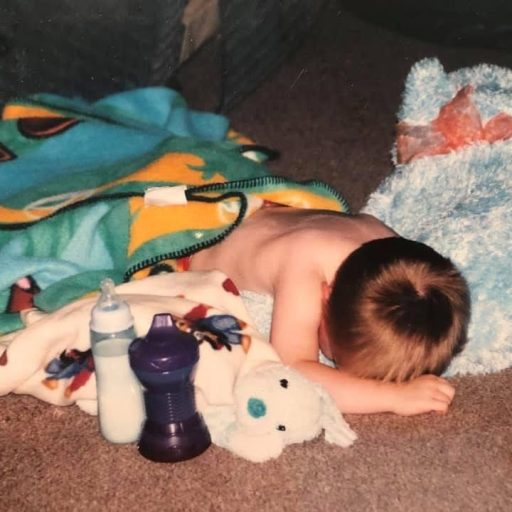
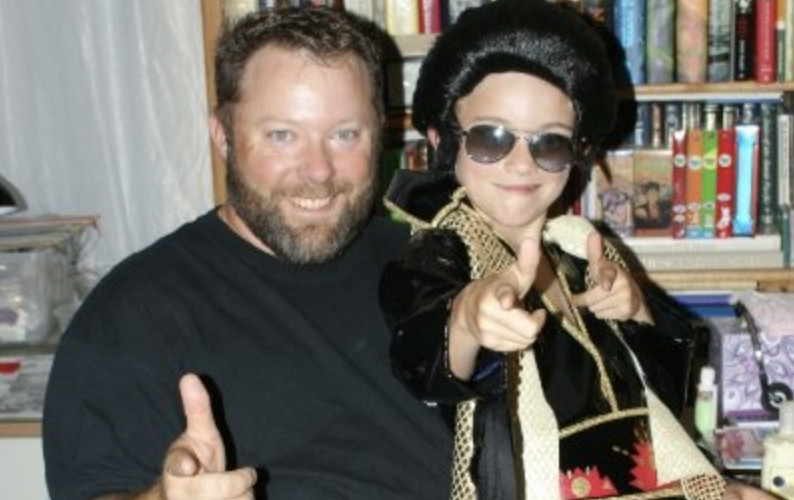
(Eight-year-old me, sequins and all, dressed as Elvis Presley for Halloween 2009, absolutely convinced I was born to perform—standing proudly next to my dad, Jason.)
There is no denying it: pop culture raised me.
Some of my earliest memories glow with pop culture, bright and alive. I am seven years old, sitting in the bed of my parents’ prized pickup trailer at our favorite vacation spot in Bodega Bay, watching Katy Perry’s Hot N Cold music video on a small screen that felt like the whole world. Dillon Beach, the smell of Velveeta queso, and a pop anthem that still makes me smile.
Award shows came next. I watched the Country Music Awards over my parents’ shoulders, barely understanding but fully enchanted. And then there was Lady Gaga’s Paparazzi performance on MTV with my older sister, messy and brilliant and unforgettable. That was the day I learned pop culture could be art.
It saved me again and again through every version of myself. I poured myself into fandom pages like some kids poured themselves into sports. I ran a Troye Sivan Tumblr that somehow found 150,000 followers, created a Lorde gif page during the Melodrama era, an Instagram account devoted to Norwegian pop singer Sigrid, and even a tiny Pop Crave–style Twitter account I treated like my own little newsroom.
Social media became the backdrop of my adolescence. I begged my mom to let me make a Facebook account, not just because my friends had one but because I wanted my own Farmville farm. I immediately liked every artist I adored: Michael Jackson, whose 2009 passing sent me deep into an Old Hollywood obsession, Marilyn Monroe, Elvis (who I dressed up as one Halloween), and every pop star of the moment like Justin Bieber, Demi Lovato, and Ariana Grande, who has since gone from thank u, next to starring in Wicked.
I have always been devoted to culture: endless playlists, movie marathons (I have watched over 90 films this year on Letterboxd), even niche art forms like ballet and opera. I spend hours reading celebrity gossip and trivia, comparing Patti LuPone’s and Audra McDonald’s Grammy counts (both have two, though Audra lost one nomination while Patti is two for two). I inhale memoirs too. Right now, I am rereading Ina Garten’s Be Ready When the Luck Happens alongside Barbra Streisand’s My Name is Barbra, which is literally Bible-length.
There isn’t one exact moment when pop culture consumed me; it’s always been there, evolving as I did. My old bedroom was Old Hollywood–themed, plastered with posters of Elvis, Marilyn, and Audrey. My favorite movie was Breakfast at Tiffany’s (which I will still defend), and my musical obsession at the time was Cole Porter (love you, Ann). I remember anxiously waiting for my turn on our family’s Dell laptop with the blue wave design, sitting at the kitchen table, Yahoo homepage open, scrolling endlessly through the Top 10 news stories. That’s where I learned about Michael Jackson’s and Whitney Houston’s deaths and fell briefly for those strange online conspiracy theories about Elvis still being alive (I outgrew them, I promise).
But the real turning point was the introduction of my first iPhone in fourth grade. That little device became a portal to everything, illegally downloaded YouTube music yes, but also the creators and influencers who shaped the early 2010s like Connor Franta, Rosanna Pansino, Emma Chamberlain, and of course, Troye Sivan. Funny enough, at the same time I was running that 100,000+ follower Troye fan page, loyal to a fault (I have always had an obsessive personality).
By middle school, and especially by high school, my obsession with pop culture didn’t fade; it grew, morphed, and deepened. All four years of high school, my top artist was Lorde. Her deep voice, relatable lyrics, and melancholy connected with my teenage soul, which I was convinced was dark and profound. In reality, “dark aesthetics” were cool on Tumblr, but I still wore Hollister shirts, Wranglers, and Sperrys.
When Melodrama dropped in the summer between my sophomore and junior year, it changed me from a Lorde fan into a full-fledged Lorde apologist. Melodrama was its own beautifully crafted world, and I lived inside it. That summer was my first taste of independence. I could finally drive, even if most of my free time after cross-country practice and rehearsal was spent at the Angels Camp or Lodi McDonald’s just to feel like we were going somewhere.
I was sixteen, processing my first adult-sized emotions and facing my rapidly declining mental health. Everything in high school feels louder, heavier, brighter, and Lorde’s music leaned into that heightened emotion. She made even small moments feel cinematic: being in someone’s kitchen after a party (Homemade Dynamite) or sitting alone in a bedroom feeling misunderstood (Liability).
But then there was Taylor.
I need to dedicate a whole post just to Taylor Swift someday because she’s been with me through every season of my life: childhood, adolescence, and now adulthood. She’s always been there, but my love for her reignited after the release of her edgy sixth studio album Reputation and again with her stunning quarantine album Folklore. Taylor became my guiding light from 2018 onward. She’s not for everyone and she’s not perfect, but she doesn’t need to be. Her music has shaped me in ways I’ll never fully explain, and I will always be grateful for her voice through my darkest and brightest moments.
Others shaped my pop culture education too. There was the junior-year AP Language and Composition project I did on Amy Winehouse, immersing myself in her genius and tragedy, or the moment I met my best friend Jill when we shared an earbud listening to Lady Gaga’s country-pop album Joanne while reading Shakespeare in Ms. Floyd’s Honors English class. Pop culture wasn’t just a hobby by then; it was how I formed friendships, how I made sense of myself, how I survived.
Lana Del Rey’s impact on me came in a more subtle, poetic, and devastating way. In the fall of 2019, she released her sixth studio album Norman Fucking Rockwell! and it became the quiet soundtrack to one of the most chaotic chapters of my life.
It was my first semester of college in San Francisco, and I was unraveling. I lost my grandma, a grief that felt like losing a piece of home. My first “serious” relationship ended in heartbreak and humiliation; he slapped me in front of my friends on the very first day of undergrad classes. I was battling both mental and physical health issues, trying to hold it all together while feeling my body and mind betray me. I even got jumped, another brutal reminder of how fragile life could feel in a big city.
All of it, the pre-grief, the post-grief, and the grief for the life I thought I was stepping into, crashed together. And through it all, Norman Fucking Rockwell! played softly in the background, an album that didn’t demand attention but wrapped itself around my pain like a weighted blanket. It gave me space to feel sorrow without judgment, to sit with everything I couldn’t yet name. March 2020 would come and tear apart whatever stability I thought I had left, but in that fall, Lana’s voice was the one steady thing that understood how broken and beautiful life can be at the same time.
COVID gave me something I didn’t expect: time. Time to dedicate not just to pop culture, but to politics, as the world unraveled in the lead-up to the 2020 Presidential Election. I was finally old enough to vote, to feel like my voice carried some kind of weight, and I was hungry to understand the chaos around me.
Music became my lens for processing it all. Albums like Taylor Swift’s Folklore, Dua Lipa’s Future Nostalgia, Rina Sawayama’s Sawayama, and Phoebe Bridgers’ Punisher became companions in isolation. Each one reflected a different side of what it felt like to be 19 and overwhelmed: the quiet storytelling of Folklore when I needed stillness, the neon disco rush of Future Nostalgia when I craved escape, the genre-bending rage and love of Sawayama when I needed to feel resilient, and the haunting intimacy of Punisher when the sadness felt too big to name.
Somewhere in that stillness, I became more poetic. COVID forced me inward, and in that solitude, I started looking for optimism and hope in music because the outside world felt hopeless.
At the same time, I fell into a new film obsession. Jill and I spent countless nights on “Netflix Party,” watching movie after movie, logging each one on a homemade Google Sheet. This was before Letterboxd became cool. I like to think those late-night movie marathons shaped my now fully realized Letterboxd, AMC A-List self, giving me a love for film that matched my love for music.
These albums, those movies, and those moments didn’t give me answers, but they gave me space to reflect on myself, on the broken systems I was just beginning to understand, and on the possibility that even in despair, art can still carry us forward.
Pop culture, and its international influence, has followed me everywhere I’ve gone. In Tunisia, Italy, France, the Dominican Republic, and the countless other countries I’ve spent time in, I’ve made it my duty to learn about each culture through its pop culture.
In Belgium, I found myself in the passenger seat of the Favaro family’s car, laughing as we blasted GIMS’ “La même,” a Congolese-French pop hit featuring Vianney that’s cringy by some standards but still irresistibly catchy. In Paris, nightclubs pulsed with music I couldn’t always understand lyrically but somehow felt deeply.
And then there was Tunisia. Tunisian and Middle Eastern music captivated me like nothing else, pulling me closer to a cultural rhythm that felt both foreign and familiar. I wandered the Medina of Tunis with the voice of Hedi Jouini, a legend of traditional Tunisian music, ringing through my headphones. DAM, the Palestinian rap group known for revolutionist lyrics, gave me a soundtrack of resistance and resilience, one that echoed through winding alleys and open markets as if the city itself was alive and breathing to their beat.
Pop culture in my family has its own rhythm, its own traditions. Christmas isn’t Christmas without watching National Lampoon’s Christmas Vacation, a classic I have seen more times than I can count, but it still makes my mom laugh like it’s the first viewing. Disneyland and Disney culture hold a special place for us too, especially for my mom and sister, who still go every Halloween, decked out in Maleficent gear and surrounded by memorabilia that fills our home with a kind of magic that feels eternal.
My dad has always been tied to laughter for me. He reminds me of Shrek, Open Season, and the kind of goofy joy that makes everything lighter. One of my earliest memories is sitting in my sister’s little blue truck, promptly named Blue Bunne, blasting Don’t Cha by the Pussycat Dolls as if life couldn’t get better.
I think about the time I dragged my entire family to see A Star Is Born after my fifth solo viewing. My dad sobbed like a baby while my sister was visibly pissed (I stand by that choice, by the way). Music ties us together too: the Bee Gees always remind me of my dad’s parents, bagpipes of my mom’s parents, and “Cornet Man” from Funny Girl (the Lea Michele version, specifically) of falling in love with Jake in the winter of 2022.
Even the TV theme songs from my childhood like The Big Bang Theory, King of Queens, Judge Judy, Everybody Hates Chris are time machines to the early 2000s, a soundtrack for the little moments of growing up. My family’s love for reality TV rubbed off on me too. My boyfriend, my sister, and my mom all share my guilty obsession with Vanderpump Rules and The Challenge. I even found myself listening to Scheana Shay read her memoir My Good Side, and honestly, I loved it.
Even now, pop culture is woven into the fabric of my daily life. My boyfriend Jake and I spend hours watching Saturday Night Live clips on YouTube, laughing until our stomachs hurt at Heidi Gardner skits, or catching up on Safiya Nygaard’s latest experiments like the time she melted every Yankee Candle into one chaotic creation or took the Amtrak from Emeryville to Chicago just to see what it was like. Our personal dialect is an amalgamation of pop culture references, bursting into songs like “Don’t Cry for Me Argentina” from Evita or “Skid Row” from Little Shop of Horrors at random moments.
What I’m trying to say is that pop culture has always been there for me. When no one else was, it strangely was. A John Denver or Blake Shelton song could instantly take me back to my grandma’s arms. Watching Call Me By Your Name reminds me of the slow burn of being gay when I felt like I shouldn’t be. Listening to Golden Hour by Kacey Musgraves carries me to the county fair, to warm summer nights where, for a moment, I felt free and comfortable in my own skin in my hometown.
Pop culture has never been just something to watch or listen to. It has been comfort, identity, and connection. It has held me when life didn’t.
Until next time,
Jared ❤
 Jaredbiz.Blog
Leave a comment