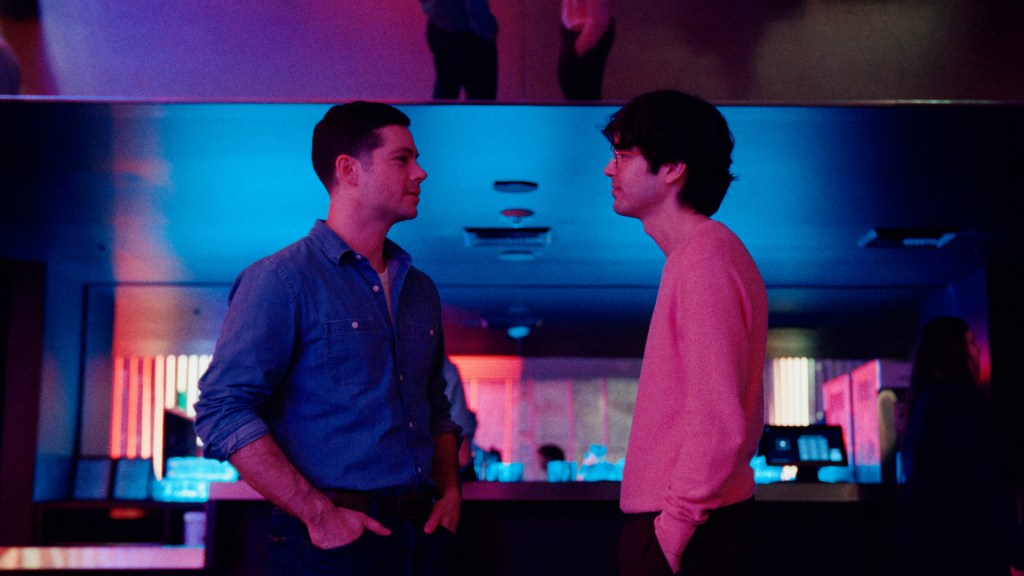
Twinless is a beautifully unsettling indie film that blends grief, identity, and fragile human connection into something that feels both intimate and disorienting. At its core are two unforgettable performances: Dylan O’Brien, tasked with the dual role of Roman and his late twin Rocky, and James Sweeney as Dennis, a man grappling with his own shadows. Together, they deliver raw, layered portrayals that make the film resonate long after it ends.
The craftsmanship is immediately evident in the editing. Nikola Boyanov’s cuts are sharp yet restrained, allowing scenes to linger when silence matters more than dialogue and tightening when emotions threaten to overwhelm. Flashbacks weave seamlessly into the present, building character instead of serving as exposition, while occasional visual echoes remind us of the twin motif without ever becoming gimmicky. It’s purposeful editing that quietly elevates the story’s emotional stakes.
Complementing this is Jung Jae-il’s haunting score, which acts as both comfort and intrusion. Known for his work on Parasite and Squid Game, he crafts a soundtrack that slips in with subtlety and then swells with unease at just the right moments. The music never overpowers the performances, but instead amplifies the tension between grief’s quiet weight and the chaos of truths that refuse to stay hidden.
The pacing is a masterclass in controlled escalation. The film begins contemplatively, almost cautiously, giving grief the space it demands. But as Dennis’s secrets emerge and Roman’s fragile sense of self begins to unravel, the tempo accelerates. By the final act, the audience is swept into a rhythm that feels deliberately unstable, mirroring the emotional disorientation of the characters. It’s never slow, never rushed—just uncomfortably alive.
What makes Twinless so clever is its refusal to settle into the story you expect. It plays with themes of doubling, identity, and authenticity not through cheap twists but through subtle choices in dialogue, costume, and framing. Every mirrored gesture or echoed phrase deepens the sense of duality, so when revelations hit, they feel inevitable rather than manipulative. The film moves fluidly between humor, sorrow, and moral ambiguity, creating a tonal texture that’s unpredictable but never careless.
At the heart of it all are the performances. O’Brien embodies two halves of a broken mirror: Roman, haunted and restrained, and Rocky, charismatic and untamed. His physicality shifts so convincingly that you never question the presence of both twins, even though only one survives. Sweeney, meanwhile, makes Dennis achingly human in his contradictions—funny yet desperate, caring yet destructive, lovable yet hard to trust. Both actors embrace the rawness of their characters, never smoothing over the messiness that makes them believable.
The film isn’t flawless. Some tonal shifts arrive so abruptly they risk pulling you out of the narrative, and certain subplots feel under-explored, leaving side characters adrift. The ending, powerful as it is, leaves some threads intentionally unresolved—a bold choice that may frustrate those seeking neat closure. But these quibbles don’t diminish the film’s impact; they’re the imperfections of a work unafraid to take risks.
Ultimately, Twinless is an emotionally daring, stylistically precise film that lingers like a bruise. Its editing and soundtrack intertwine to heighten every moment, its pacing carries you from reflection to freefall, and its two leads deliver performances as clever as they are raw. It’s not comfortable viewing, but it is necessary—an unflinching exploration of loss, identity, and the desperate ways we reach for connection.
4.5 out of 5 stars.
Until the next one,
Jared ❤
 Jaredbiz.Blog
Leave a comment